

Fraud Lens
Fraud Lens is Prembly's centralized fraud intelligence engine and proactive defense network. Rather than forcing organizations to fight financial crime in isolation, Fraud Lens connects businesses to a shared consortium—the Fraud Lens—where verified bad actors, compromised accounts, and synthetic identities are cataloged with forensic evidence.
When a fraud ring or bad actor attacks one organization in the Prembly ecosystem, the entire network is instantly protected before that same entity can transact elsewhere.
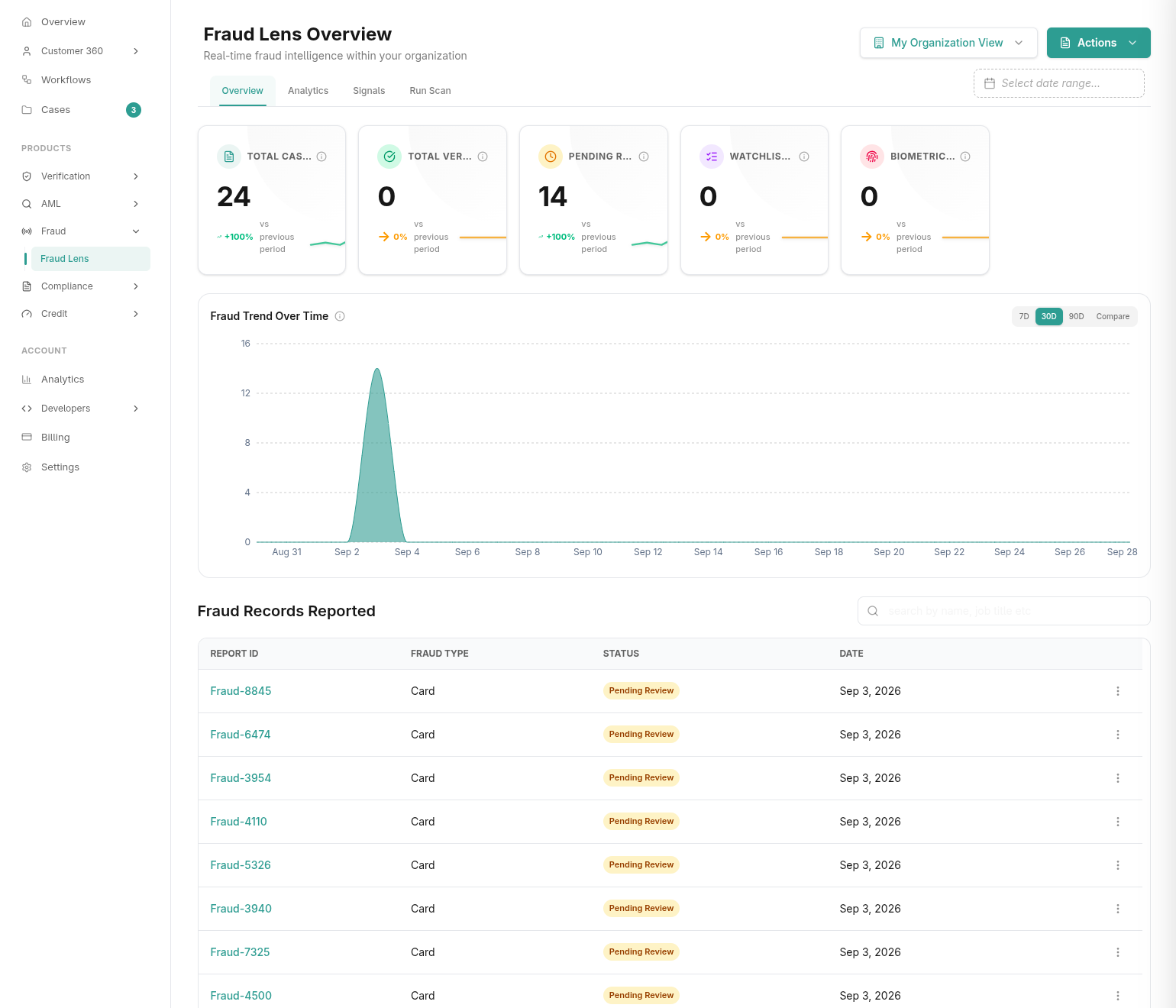
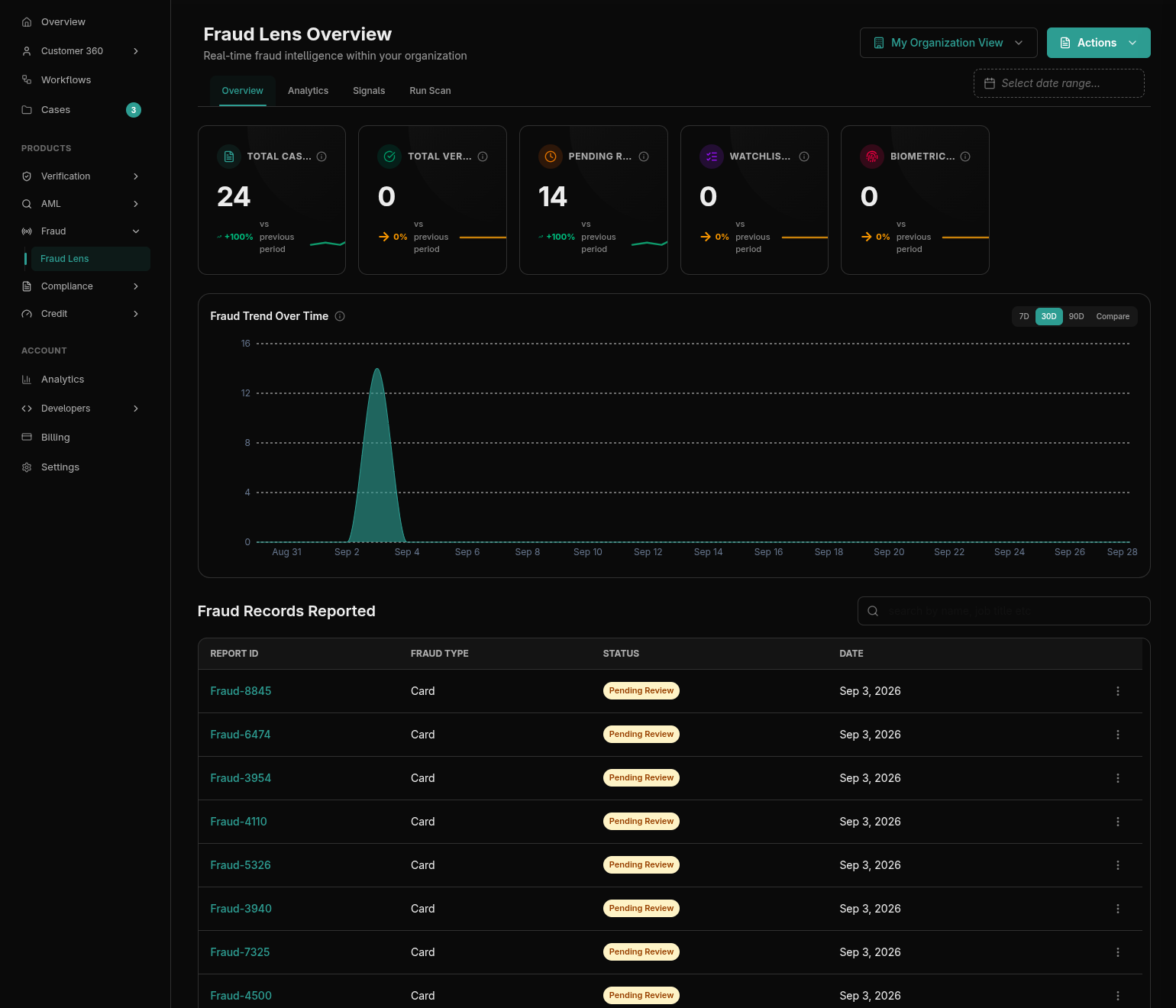
1. What Businesses Stand to Gain
Traditional fraud defenses only react after an attack impacts your balance sheet. Fraud Lens transforms security into a pre-emptive, collective shield. By tapping into cross-institutional Network Overlap, businesses detect bad actors at the door without adding friction for legitimate customers.
Industry-Specific Impact
1. Fintechs & Neobanks
- The Threat: Rapid, automated account creation, wallet draining, account takeover (ATO), and mule account creation used to launder stolen funds.
- What You Gain:
- Pre-Emptive Sign-Up Shielding: Stops fraudsters from hopping between digital wallets and challenger banks. If a user is flagged for card draining at one fintech, their identity markers are blocked across all participating neobanks.
- Reduced Manual Review Overhead: High-confidence matches (
>= 0.95) trigger automatic blocks or step-up authentication, reducing operations queue volume by up to 80%.
2. Digital Lending & Microcredit
- The Threat: Loan stacking (borrowers simultaneously applying for loans across 5+ platforms within hours), synthetic identities created from stolen registry data, and intentional default syndicates.
- What You Gain:
- Elimination of Loan Stacking: Instantly flags applicants who have defaulted or executed simultaneous loan runs across peer lenders.
- Synthetic Identity Detection: Uses 1:N facial biometric vector scanning to catch individuals reusing the same face across different names or national identity numbers (e.g., NIN, BVN).
- Direct NPL Reduction: Prevents non-performing loans (NPLs) and balance-sheet write-offs before capital is disbursed.
3. E-Commerce & Marketplaces
- The Threat: Card-Not-Present (CNP) fraud, triangulation schemes, and "friendly fraud" (cardholders dishonestly filing chargeback disputes after receiving goods).
- What You Gain:
- Chargeback Ratio Protection: Identifies serial dispute abusers and compromised credit cards before checkout, keeping dispute ratios safely below Visa and Mastercard monitoring thresholds (VAMP/MATCH).
- Merchant Imposter Screening: Vets incoming marketplace sellers against known fraudulent corporate entities and bad-actor storefronts.
4. Traditional Banking & Financial Institutions
- The Threat: Organized financial crime syndicates, stolen bank credentials, unauthorized wire diversions, and regulatory non-compliance fines.
- What You Gain:
- Inter-Bank Threat Intelligence: Uncovers cross-institutional money laundering and coordinated syndicate activity before illicit funds transit downstream.
- Privacy-Preserving Collaboration: Organizations share actionable threat signals and verified bad-actor hashes without exposing customer PII to competitors, ensuring full compliance with regional data protection mandates (GDPR, NDPR).
- Regulatory & Audit Assurance: Every match includes a cryptographically verifiable audit trail suitable for regulatory filings and law enforcement dossiers.
2. Core Threat Classifications
Fraud Lens categorizes threat vectors into 11 distinct operational types to enable granular rule triggers:
| Threat Category | Description | Primary Impacted Sector |
|---|---|---|
| Card Fraud | Unauthorized transactions executed using stolen or cloned payment cards. | E-Commerce, Fintech |
| Synthetic Identity | Fabricated identities combining real and fake credentials with re-used photos. | Lending, Banking |
| Account Takeover (ATO) | Compromised credentials used to hijack legitimate user accounts. | Fintech, Banking |
| Loan Stacking | Coordinated, rapid borrowing across multiple credit providers to default. | Digital Lending |
| Chargeback Fraud | Fraudulent dispute claims filed after legitimate purchase delivery (Friendly Fraud). | E-Commerce, Merchants |
| Triangulation Fraud | Compromised storefronts routing stolen payment data through third-party shoppers. | Marketplaces |
| Money Laundering | Layering illicit funds through multiple accounts and digital wallets. | Banking, Fintech |
| Identity Theft | Impersonation of legitimate consumers using leaked government identifiers. | All Sectors |
| Phishing | Credential harvesting through deceptive communication and spoofed interfaces. | All Sectors |
| Merchant Fraud | Creation of shell merchant profiles to process fraudulent transactions. | Payment Gateways |
| Other / Custom | Emerging fraud vectors and customized compliance violations. | All Sectors |
3. Detection & Screening Modalities
Organizations can interrogate the Fraud Lens through three primary modalities:
1. Identity & Attribute Scanning
Query individual identity markers—such as National Identity Numbers (BVN, NIN, SSN), bank account numbers, phone numbers, or email addresses—directly via REST API or the dashboard.
POST https://api.prembly.com/api/v1/fraud/portal/id-scan/
X-API-Key: <your_api_key>
Content-Type: application/json

{
  "id_type": "bvn",
  "id_number": "12345678901",
  "fraud_category": "bank",
  "verified_only": true
}
2. Facial Vector Biometric Scanning (1:N Matching)
Fraud rings often alternate names and identity numbers while using the same physical photograph. Fraud Lens converts applicant selfies into high-dimensional facial embeddings and performs 1:N similarity searches across the entire Fraud Lens repository.
- Similarity Score
>= 0.95(Critical Match): Definitive match with a verified bad actor. Automatically flags or terminates processing. - Similarity Score
0.70 – 0.94(Strong Match): Elevated probability of synthetic manipulation or family impersonation. Routes into Case Management for operator review.
Face Scan
Face comparison asks whether two images match. Face Scan asks a broader question: has this face been seen before, and in what company?
POST https://api.prembly.com/api/v1/fraud/face-scan/
X-API-Key: <your_api_key>
Content-Type: multipart/form-data
The scan runs three layers of analysis against a single submitted face:
- Multiple ID Detection — checks whether the same face appears across several national identity records (BVN, NIN, Passport). One face bound to several distinct identities is a well-documented identity-farming pattern.
- Fraud Bank Matching — matches the face against verified fraud reports, returning fraud categories, amounts, and report detail for both confirmed cases and unverified submissions.
- Identity Consistency Analysis — scores overall identity confidence and raises security flags where information conflicts across sources.
The response carries an overall risk score from 0–100, a risk level of LOW, MEDIUM, HIGH, or CRITICAL, and an analysis_summary naming the specific pattern detected — for example, "Face matched to 3 different IDs".
For the biometric channels that compare and bind faces to identity records, rather than screening them for fraud, see the Biometrics guide.
3. Bulk Historical Audits
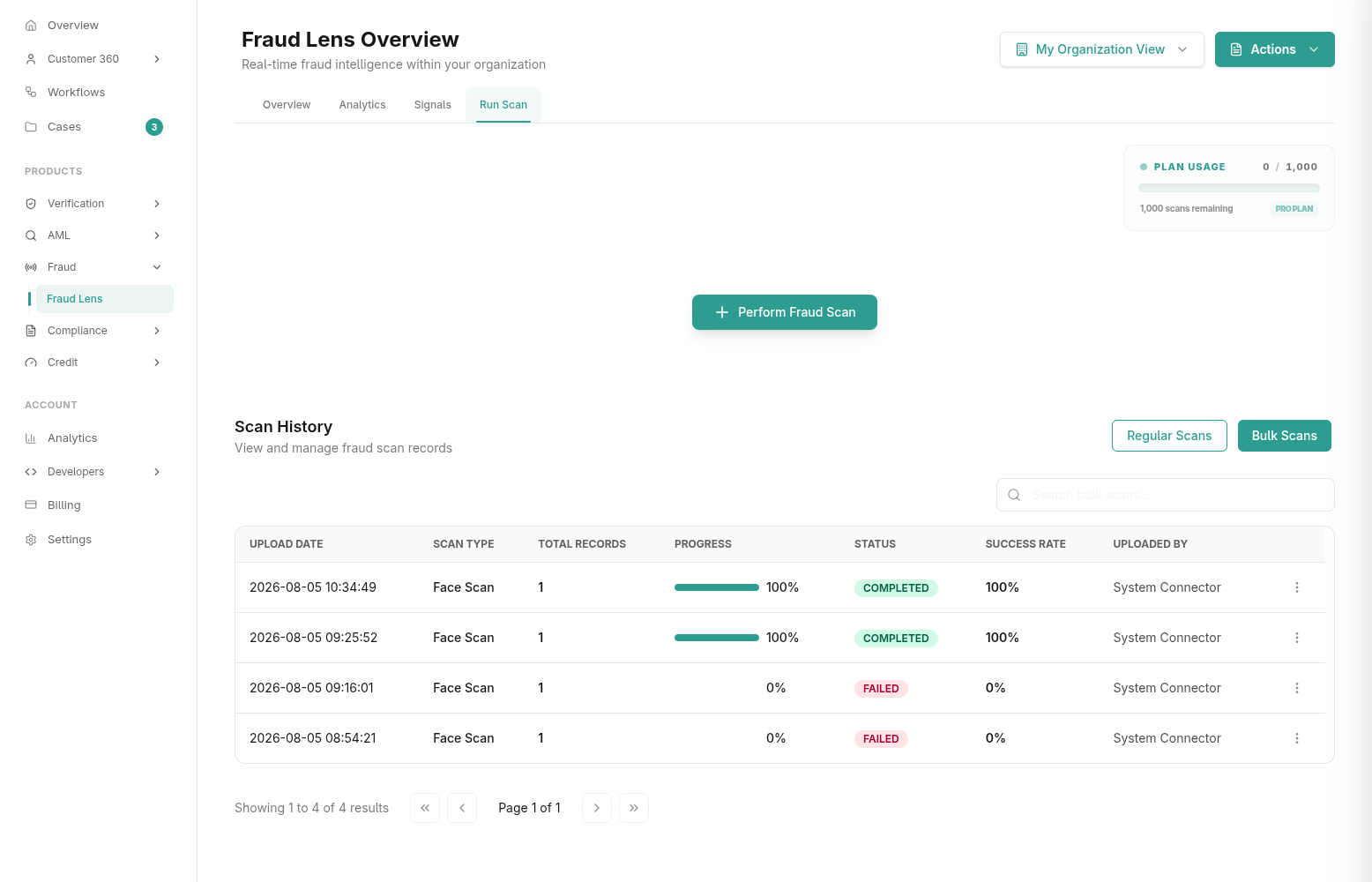
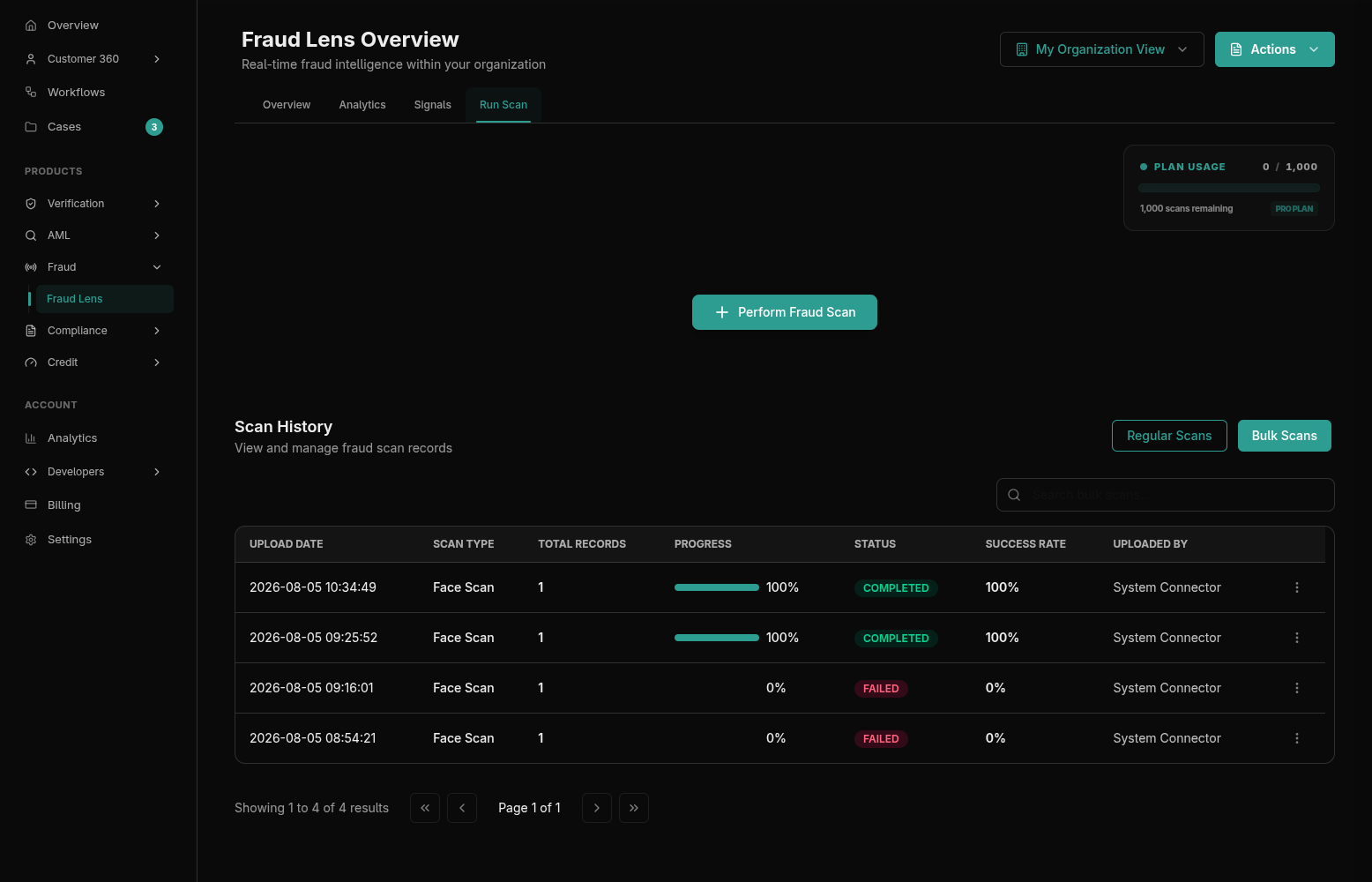
Audit existing customer portfolios, historical transaction batches, or merchant backlogs without hitting rate limits by uploading structured spreadsheets (.xlsx).
- Format Spreadsheet: Include columns for identity parameters (
id_type,id_number) or facial image URLs (image_url). - Dispatch Scan: Upload via the dashboard or submit programmatically to
POST /api/v1/fraud/bulk-scan/upload/. - Download Results: Receive an enriched export containing row-level
result_risk_score,result_risk_level, andresult_fraud_detectedflags.
4. Contributing Reports to the Fraud Lens
Organizations actively strengthen the consortium by submitting verified fraud cases:
Submission Workflow
- Suspect Details: Input legal names, date of birth, state/region, and known identifiers (BVN, NIN, national ID).
- Financial & Fraud Classification: Select the fraud category (e.g., Bank, E-Commerce, Telecom, Insurance), attack type, financial institution involved, account number, and monetary amount at risk.
- Forensic Evidence: Attach supporting documentation (PDF dispute forms, transaction slips, chat transcripts, or altered identity images).
- Consent & Attestation: Formal attestation that the submitted data represents verified fraudulent activity.
Review Lifecycle
Submitted cases undergo rigorous validation to prevent false accusations or retaliatory reporting:
Pending Review: Newly submitted report entering verification queues.Under Review: Evidence is audited against third-party records and supporting proof.Approved: Case is confirmed, and the threat signatures are propagated across the global Fraud Lens shield.Declined: The submission lacked conclusive forensic evidence and was rejected.
5. Ecosystem Integration
Fraud Lens functions as an integrated risk signal across the Prembly suite:
- Customer 360: Fraud hits automatically populate the customer's risk profile under the dedicated Fraud Tab, updating their composite risk score and alerting relationship managers.
- Workflows: Embed Fraud Scan nodes directly into automated onboarding pipelines to terminate suspect applicants before completing identity enrollment.
- Case Management: Anomaly matches and borderline similarity scores automatically spawn collaborative investigation cases for compliance and legal teams.
- Automated Webhooks: Receive immediate notifications (
fraud.match_detected,fraud.report_approved) whenever an applicant or monitored account triggers a network hit.
Transaction Monitoring (TM)
A complete guide on how to adopt, customize, and manage industry-specific rule groups to monitor financial transactions in real-time via Dashboard and API.
Biometrics Overview
How Prembly binds an identity record to a live person — the biometric surfaces available, how to choose between them, and how to read the scores they return.